
A Comprehensive Strategy Pioneered by NXTR | Fuji's vision for next generation placements
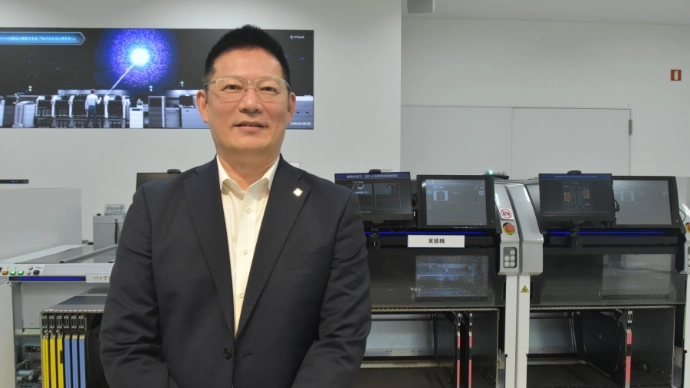
Robotic Solutions Division General Manager,
FUJI CORPORATION
- Global market trends and Fuji regional support
- NXTR: Ready to compete in any market - Modular concept, Target ZERO -
- Fuji's unmatched abilities in automation
- Supporting demand in growth areas such as AI servers and semiconductors with NXTR
- Aiming to be the industry leader through a comprehensive strategy (region x industry)
Raising geopolitical risks, supply chain restructuring, and worsening labor shortages are dramatically changing the manufacturing landscape. I expect the environment surrounding the manufacturing industry will continue to change dramatically. Against this backdrop, Fuji, a manufacturer of electronic component pick and place machines, is strengthening its presence through advanced automation technologies and flexible production capabilities. In particular, demand for smartphones, AI servers, and semiconductor-related products is expanding in Southeast Asia and India, driving growing interest in Fuji’s solutions. In this interview, we spoke with Takeshi Sato, General Manager of the Robotic Solutions Division, about Target ZERO, our comprehensive strategy, and the strengths of the NXTR electronic component pick and place machine.
Global market trends and Fuji regional support
Risks facing the manufacturing industry—such as the situation in Ukraine, U.S. tariff policies, and the situation in the Middle East—are increasing day by day. These risks are affecting a wide range of areas, including supply chains and energy, and we live in an era where the future is increasingly difficult to predict. That is precisely why I believe it is crucial to be prepared for change and to respond as quickly as possible.
Traditionally, manufacturers established production facilities in regions with lower labor costs or close to consumer markets. Recently, however, rising geopolitical risks have encouraged many companies to diversify and decentralize their operations. However, relocating production is not easy. The cultural, infrastructure, logistics, and human resources environments vary from country to country.
Recruiting is a particularly significant challenge. Developed countries face labor shortages caused by aging populations and declining birth rates, while Southeast Asia and India experience high workforce mobility. There are many cases where trained personnel do not stay with the company, which has become a major concern on the manufacturing floor.
Yes. There are two main factors driving this trend. The first is the desire to build production systems that do not rely on people. The goal is not simply labor reduction but reducing reliance on individual workers while maintaining stable quality and high operating rates.
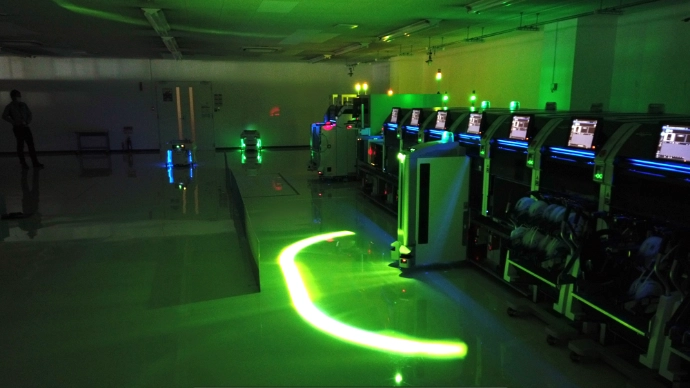
The second is increasing production capacity. Automation enables production to continue during periods when it would traditionally stop, such as during breaks. By preparing for nighttime operation during the day, it becomes possible to continue automated production for set periods during the night.
I believe our products are valued for both their functionality and performance, as well as their automation capabilities. At the core of this is the modular concept inherited from the NXT series, the predecessor of NXTR. Machines and units are designed to be compact and easily interchangeable, allowing improvements in productivity per area while flexibly accommodating diverse production requirements.
For example, in addition to being able to install more machines within the same floor space, the ability to change heads and feeders with a single touch makes the machines flexible to support high-mix production. Furthermore, our machines are highly regarded for their stable operation and productivity during mass production.
In addition, one of Fuji’s unique strengths lies in our automation solutions. I believe that our ability to propose solutions that encompass not only functionality and performance but also automation is what drives Fuji’s competitiveness.
Yes. We have established a global service network and place great emphasis on supporting customers to keep their machines running. Since these are robots, it is impossible to completely eliminate maintenance or malfunctions. What matters is how quickly operation can be restored when issues occur. Equipment downtime represents a major loss for customers. I believe building systems that minimize downtime has earned us their trust.
NXTR: Ready to compete in any market - Modular concept, Target ZERO -
NXTR was developed as a further evolution of the existing NXT series. Market demands for performance and automation have risen to levels that could no longer be met by simply extending the capabilities of existing systems. To respond to this, we developed NXTR as a completely redesigned platform that builds on our modular concept while addressing these market needs.
Today, the market demands not only higher accuracy for increasingly smaller components but also high accuracy for larger and heavier components. Fuji is expanding its capabilities to support all types of placement requirements, from small circuit boards used in smartphones and semiconductor applications to large server boards.
At Fuji, we have placed great importance on the three zeros: zero placement defects, zero machine operators, and zero machine stops. However, we felt that focusing only on these goals risked limiting us to optimizing current conditions.
That is why we have introduced a new concept: zero placement limits. This reflects our commitment to constantly asking, "What is the next barrier we must overcome?", an attitude that rejects conventional limits and embraces the mindset of "If it is needed, we will make it happen."
By adopting this concept, we have become more focused on both solving problems and discovering new challenges.
Fuji's unmatched abilities in automation
One of Fuji's unique strengths is its automation solutions. What sets Fuji apart is not just our ability to enhance functionality and performance, but our capacity to integrate these improvements with automation solutions. Anticipating a future of increasing labor shortages, Fuji began developing automation technologies at an early stage. While electronic component pick and place machines can perform high-speed, high-accuracy operation, they traditionally still required human involvement for tasks such as component replenishment. Fuji believed that manufacturers would eventually need production lines capable of operating continuously without operators standing in front of the line to replenish components. As a result, we pursued working to develop a fully automated system that includes parts replenishment. As a result, we have created lines that free operators from changeover changes and component replenishment tasks, enabling automatic production to continue for set periods even during night. We believe these unique characteristics of Fuji contribute to our competitiveness.
Supporting demand in growth areas such as AI servers and semiconductors with NXTR
Electronic devices have evolved over the years. Personal computers drove the market in the 1990s, mobile phones in the 2000s, and then smartphones. Today, AI servers and semiconductor applications have become the new center of growth.
We have always focused on anticipating the needs of each era and delivering optimal solutions. We believe AI will become increasingly widespread and eventually an ordinary part of everyday life. To meet this demand, we are continuing our technological development and making proactive investments.
In the AI server sector, large circuit boards require high-accuracy placement of both small components and large, heavy components. In the semiconductor sector, there are cases requiring placement accuracy at the 10-micron level while maintaining high speed, demanding significantly more advanced technology than before.
To meet these requirements, comprehensive technologies including vibration control and vision processing are essential. Building on decades of mechanical design expertise, Fuji has continuously been developing high-speed and high-accuracy control technologies and advanced vision processing technologies. I believe these efforts are a major reason for the strong recognition we receive today.
Aiming to be the industry leader through a comprehensive strategy (region x industry)
At Fuji, we are pursuing an all-encompassing strategy to meet every production need, without limiting ourselves to specific regions or industries.
I expect the environment surrounding the manufacturing industry will continue to change dramatically. The challenges our customers face, such as geopolitical risks, labor shortages, and the increasing sophistication of electronic devices, are becoming increasingly complex.
In this environment, what matters most to us is not simply providing machines but solving our customers’ challenges directly. We strive to understand what is happening on the factory floor, anticipate changes, and propose new value. I believe it is important to continue taking on the challenge of developing new technologies and solutions under the concept of zero placement limits.
Fuji will continue to unlock new possibilities for our customers’ production sites and contribute to the evolution of global manufacturing.


Related Stories


Sharing the story of our journey