
Core Technologies Underpinning Fuji’s Competitiveness | Technological development at the Development Center: Looking beyond high speed and high accuracy
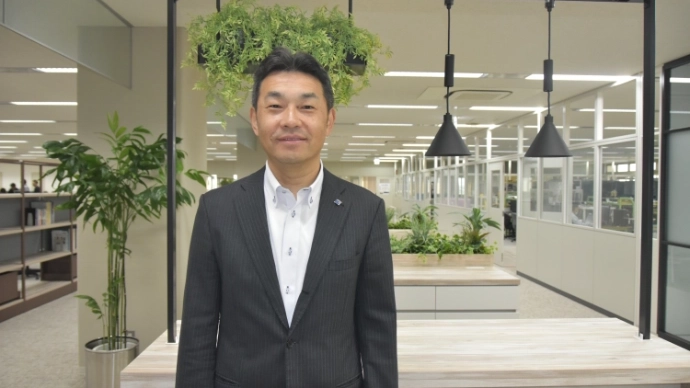
Development Center General Manager,
FUJI CORPORATION
- Development Center mission: Further strengthening the width and depth of technology
- If it doesn’t exist, we create it ourselves - Development of linear motors capable of high speed and high accuracy
- The "modular concept" innovation that transformed customers’ production sites
- Towards the next generation of manufacturing that exceeds our customers’ expectations
From smartphones to cutting-edge AI servers, the miniaturization and high-density integration of semiconductors and electronic components are advancing rapidly. To maintain its competitiveness in the field of electronic component pick and place machines, it is essential that Fuji continuously develops advanced technologies that anticipate future market needs.
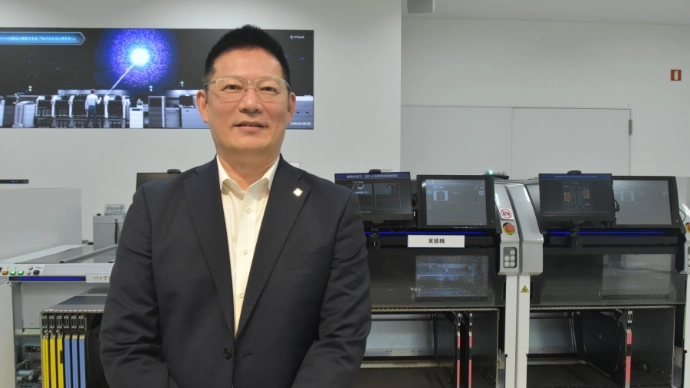
The Development Center is an organization dedicated to developing the core technologies that serve as the source of Fuji’s competitiveness. We spoke with Masatoshi Fujita, General Manager of the Development Center, about the cutting-edge development strategies the center is advancing, the story behind the modular concept, which is the innovative design philosophy adopted in the NXT series that launched in 2003, and the journey of the engineers who continue to pursue global leadership.
Development Center mission: Further strengthening the width and depth of technology
The primary mission of the Development Center is to develop core technologies in-house that serve as the foundation of Fuji's competitiveness and directly contribute to improving product performance. Because Fuji’s products are required to achieve extremely high levels of performance, it is often essential for us to create advanced technologies from scratch ourselves when suitable solutions do not already exist.
To enable business divisions to commercialize and incorporate these advanced technologies, we focus on developing the core technologies themselves prior to commercialization.
The Development Center approaches core technology development along two axes. The first is deepening core technologies—pushing positioning accuracy and speed, which are directly linked to the production capabilities valued by customers, to the absolute limit. This can be considered the vertical axis or depth. If the underlying core technologies are exceptionally strong, they can elevate the performance of the entire product lineup regardless of how diverse it becomes. The other is the expansion of the horizontal axis, which involves widening our technological variations to meet the diverse requirements of our customers. By continuously strengthening both the vertical and horizontal axes, I believe we can ensure that Fuji’s technological superiority will remain unshakable, even in a rapidly changing market.
If it doesn’t exist, we create it ourselves - Development of linear motors capable of high speed and high accuracy
In Fuji’s main pick and place machines, one of the most critical performance metrics is speed (productivity). The process of picking up components and placing them accurately and rapidly onto a circuit board is very straightforward. It is precisely because of this that the pursuit of speed directly translates into benefits for customers.
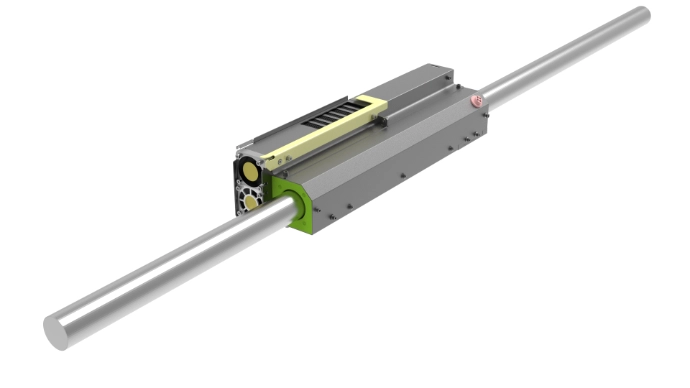
I was involved in the development project as an engineer from the very start of the NXT series, which later became our flagship product. While the early NXT models used ball screws, adopting linear motors was essential to stay ahead of the competition. However, when we tried to achieve the speeds we were aiming for, we searched manufacturers worldwide but could not find a linear motor that met our specifications.
We followed the philosophy of "If it doesn’t exist in the world, we just have to create it ourselves". While maintaining a size that would fit securely within the machine’s limited space, the development team relentlessly pursued the thrust necessary for ultra-high-speed movement, ultimately creating a linear motor specifically designed for pick and place machines. It was precisely because we established the core technology for linear motors in-house that we were able to expand its application to various products thereafter, marking a major breakthrough in Fuji’s history.
The "modular concept" innovation that transformed customers’ production sites
At the heart of the NXT series mentioned earlier lies the groundbreaking, modular concept, which was proposed by visionary leaders of that time.
This concept allows customers to reconfigure machine units on the production floor according to changes in the products they manufacture such as for example, when shifting from smartphone production to laptop production. This flexibility enabled high-mix production while simultaneously improving productivity per unit of floor space. These benefits provided substantial value to customers and ultimately helped Fuji gain even broader recognition in the global market.
However, realizing this modular concept presented significant technical challenges. To create compact, interchangeable modules, modules had to be designed with a narrow width. However, a narrow width makes the modules prone to lateral vibration, which affects the positioning accuracy of the robots. Furthermore, making units easy to replace complicated the task of maintaining sufficient rigidity at connection points. Achieving both high-speed and high-accuracy performance under these conditions was a major engineering challenge.
To address this major challenge, the entire company united to tackle the technological development. We overcame the challenge of balancing ease of replacement with structural rigidity and successfully created the NXT series, which delivered ultra-high-speed and ultra-high-accuracy performance despite its modular architecture. This innovation was highly recognized and received the prestigious 50th Ichimura Industrial Award in 2018. I believe this award represents tangible recognition of the technological development accumulated through the dedicated efforts of Fuji’s engineers.
Fuji’s electronic component pick and place machines have maintained a world-class market share for many years. While this is a source of pride, it also places significant pressure on our engineers. Expectations from customers and the market are extremely high, and there is always an assumption that Fuji can do it.
In this environment, a mindset has naturally emerged among engineers that there is no point in creating products with the same performance as our competitors. We are driven by a positive sense of duty and responsibility and the belief that maintaining the status quo is tantamount to falling behind and that we must continue to propose unprecedented new value. At the same time, we are fueled with a strong passion to meet those customers' expectations.
Importantly, this mindset is not imposed from above. It developed naturally by experiencing firsthand the differences between us and our competitors at trade shows and through visits to our customers’ sites. Above all, I feel that because the senior engineers and supervisors around us constantly approach manufacturing with such high aspirations, the DNA of a desire to take on challenges is naturally passed down to the younger engineers.
Towards the next generation of manufacturing that exceeds our customers’ expectations
What we value most in manufacturing is delivering value that exceeds customer expectations. Simply meeting the specifications requested by customers is not enough to create true competitiveness. We believe it is important to identify latent issues and needs that customers themselves may not yet recognize and to proactively develop technological solutions for them.
Fuji’s modular concept and automation technologies were born not merely from a desire to improve performance, but from the perspective of how to advance the entire manufacturing process. I feel that our current competitiveness stems from the fact that we have pursued technological development not only by chasing high speed and high accuracy, but also by advancing productivity, flexibility, and the future of manufacturing for our customers.
Today, the utilization of AI and advances in semiconductor backend processes are raising the technological requirements placed on pick and place machines even further. To respond to these changes, it is no longer sufficient to extend existing technologies. We must challenge ourselves to develop entirely new principles and core technologies.
The Development Center will continue to refine our core technologies while actively incorporating AI and advanced technologies, working to develop technologies that will support the next generation of manufacturing.


Related Stories


Sharing the story of our journey