
Making Caregiving Easier with Robots Doing the Heavy Lifting | Hug's mission to support the future of caregiving in Japan as a mobility support robot
New Business Department,
Hug project leader,
FUJI CORPORATION
- The question that started it all: "How do we support caregiving in an aging society?"
- An unexpected turn of events: wider adoption in home care than nursing facilities
- Moving away from a "robot-like" appearance toward a design that blends into daily life
- A major turning point in 2019: rapid adoption in the home care market
- Discovering benefits beyond caregivers
- Hug attracts younger talent
- Bringing the potential of care technology to more people
As the population ages, a severe labor shortage persists in the caregiving sector In particular, transfer assistance, which involves “lifting” users to move them from beds to wheelchairs or to the toilet, places a heavy physical burden on caregivers. This not only causes back pain but is also one of the factors leading to staff turnover.
Meanwhile, the shortage of care workers is becoming increasingly severe as the number of elderly people requiring care rises. Amid growing social issues such as elderly people caring for other elderly people and caregivers leaving their jobs to provide care, the question of “how do we support caregiving” is no longer just a problem for the care industry alone.
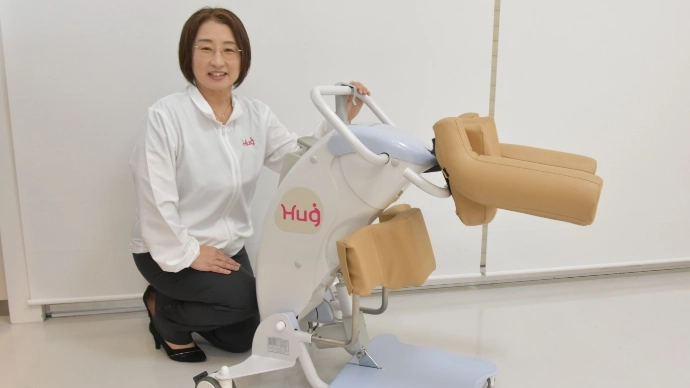
In response to these challenges, the mobility support robot “Hug,” developed by Fuji, is attracting attention as a new solution. Originally developed for care facilities, it has now been widely adopted in home care and medical settings, evolving into a tool that is expected to support users’ independence and even aid in rehabilitation.
In this interview, we spoke with the Hug project leader about the background of the development, the challenges of market expansion, and future prospects.
The question that started it all: "How do we support caregiving in an aging society?"
As the population continues to age, how to support the long-term care sector has become a major challenge. With medical costs rising and hospitals facing increasing financial pressure, the government is also working to extend healthy life expectancy and promote home care. However, there is a severe shortage of the personnel needed to make this a reality. Securing personnel is a major challenge for medical and care facilities, and it is not uncommon for job postings to go unfilled. Furthermore, the home care sector faces growing challenges, including elderly people caring for other elderly family members and a shortage of caregivers.
In response to these challenges, discussions arose within Fuji regarding whether the robotics and control technologies cultivated over many years could be applied beyond SMT pick and place machines to address more immediate social issues. It was in this context that we turned our attention to the long-term care sector. Amid growing expectations for the use of technology to address labor shortages and reduce the burden of caregiving, we embarked on this challenge as an area where Fuji’s technology could make a meaningful contribution. The result of that challenge is the mobility support robot "Hug."
In fact, what sets Hug apart is the extent to which it has been adopted in home care. We ourselves never imagined at first that the use of this service for home care would become so widespread. Hug is currently eligible for welfare equipment rental funded by the Long-Term Care Insurance System. Just like beds and wheelchairs, this program allows users to rent Hug.
However, there were some major hurdles to overcome along the way. It wasn’t enough to simply obtain certification under the Long-Term Care Insurance system; Hug wouldn’t spread nationwide unless rental companies adopted it. Since rental companies also need to hold the equipment as assets, getting them to adopt it was a major challenge in itself.
An unexpected turn of events: wider adoption in home care than nursing facilities
Initially, we had actually intended for it to be used in nursing homes. Although the first model was launched in 2016, only about 100 units were adopted by nursing care facilities.
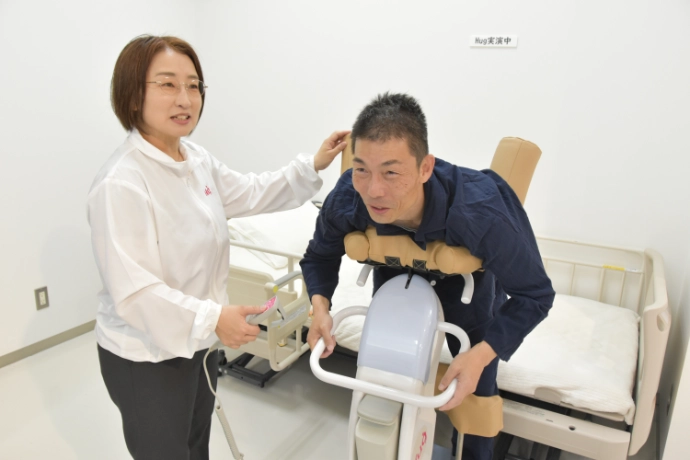
On the other hand, there were many users and their families facing urgent challenges in the home care setting. When used for home care, it is assumed that family members without specialized knowledge or experience in caregiving will be operating the system. That is precisely why it was crucial for anyone to be able to use it easily.
Above all, we focused on simplicity. We aimed for a product so intuitive that it could be used without even reading the manual.
The first model was heavier, larger, and more expensive than the current model. It weighed nearly twice as much and cost around 2 million yen, which limited its adoption even as a product for care facilities.
So, we shifted our approach to “thoroughly stripping away the unnecessary.” We stripped the product down to only the essential features the market truly needed, and focused on making it smaller, lighter, and more affordable. The result of this effort is our current flagship product, the "Hug L1."
Moving away from a "robot-like" appearance toward a design that blends into daily life
The original model had a very mechanical design. It was angular with a black frame, and to be honest, I think it gave off an impression that was hard to accept. However, when considering use in a care facility or at home, it’s important that the device matches the room’s decor. So, we opted for soft colors and shapes, aiming for a presence that blends in with the walls and furniture. It was also important that the people receiving care wouldn’t be frightened, so we aimed for something closer to a “daily tool” rather than a “robot.”
We also reduced the weight to approximately 30 kg. It is light enough for one person to carry or be loaded into a car by two people. We have also significantly revised the pricing, reducing it substantially from the initial model.
Usually, companies differentiate themselves by adding new features, right? But for us, it was the opposite.
We abandoned the "do-it-all" approach and focused solely on the features that are truly essential. I believe that’s why the market embraced it.
A major turning point in 2019: rapid adoption in the home care market
In 2019. Until 2018, we were implementing about 50 Hug units a year, but once rental companies started adopting it, that number skyrocketed ten fold. We began receiving lots of positive feedback from the home care field, with comments like, “Even I can operate this,” and “I’m so happy I can go to the bathroom without worrying about the physical burden on my family.”
In a sense, the caregiving industry is a world where everyone tends to follow the crowd. There is a tendency for adoption to spread along the lines of, "if that facility is using it, maybe we can use it too." It was really tough until we found that key person who would be the first to adopt it.
First, we had to learn about the long-term care industry. We brought on board staff with backgrounds in the long-term care industry and thoroughly studied the market structure: Where should we focus our efforts to increase adoption? Who is the key person? There were market structures and decision-making processes that were invisible from outside the industry.
With that, we went to meet some influential figures in the industry. At first, we were completely ignored, but one executive said, “Let’s give it a try.” From there, Hug spread rapidly. In new business ventures, it’s crucial to create a momentum where people think, “Since the place next door is using it, we should use it too.”
Discovering benefits beyond caregivers
Initially, the main goal was to "reduce the burden on caregivers." However, as the system was put into actual use, it became clear that it also offered significant benefits to care receivers.
For example, people who previously had difficulty getting to the bathroom due to the heavy physical burden on their caregivers could now use Hug to get to the bathroom without placing any burden on their caregivers. In some cases, people who were wearing diapers have been able to stop using them. In addition, getting out of bed more often increases physical activity, which leads to increased food intake and helps maintain bodily function. Furthermore, as their spirits have lifted and they’ve had more opportunities to get out of bed, some residents have even been able to stand up on their own without using Hug. Given these examples, expectations are growing for Hug as a device that supports improvements in users’ ADL (Activities of Daily Living), and it has recently attracted attention from professionals in the medical and rehabilitation fields.
Hug attracts younger talent
While the project team consists of about 10 members, we actually collaborate with various internal departments, including manufacturing, repairs, and customer support. Being able to leverage Fuji’s manufacturing infrastructure is a major strength.
There are also young people who join the company specifically because they want to work on projects related to Hug. Some employees were inspired to pursue this career after caring for a family member. I feel that an increasing number of young people are eager to get involved in solving social issues.
Bringing the potential of care technology to more people
I believe the most important thing is raising awareness. It cannot yet be said that the existence of such devices is widely known. It’s hard to truly understand what caregiving is like until you’re in that situation yourself. That’s exactly why it’s so hard to know how to convey it. However, there is no doubt that the number of issues requiring society-wide consideration—such as the problem of people leaving their jobs to care for family members—is on the rise.
In this context, the idea of using technology to support the long-term care sector is becoming increasingly important. In addition, the government has set numerical targets for the use of care technology in its policies, and there is a growing trend toward promoting the use of technology in the field of long-term care. In Japan, where the population is aging, long-term care is a challenge for society as a whole. We will continue working to expand the reach of Hug while enhancing its capabilities, so that it can play an even greater role in addressing the challenges of caregiving.


Related Stories


Sharing the story of our journey