
Using Robots to Reduce the Burden of Stocking Shelves in Retail Stores Building on the technological expertise, Fuji is tackling challenges in the retail industry with its multifunctional conveyance robot, Rally.
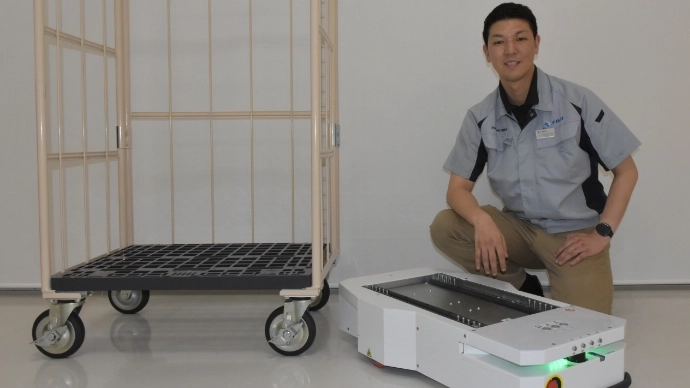
Rally project leader,
FUJI CORPORATION
- The birth of Rally, a multifunctional conveyance robot tackling labor shortages in the retail industry
- More than just development: the challenges faced by young leaders taking on the role of building new businesses
- Operating robots in unfamiliar environments: refining practicality through proof of concept
- Fuji’s culture where anyone of any age or tenure can take on new challenges
- Toward a future where humans and robots work together
Fuji is known world wide for its SMT pick and place machines. Drawing on its technical expertise, Fuji is now taking on a new challenge with Rally, a multifunctional conveyance robot designed for the retail industry. In this interview, we spoke with the Rally project leader about the background behind Fuji's entry into the retail industry and the vision behind Rally. Drawing on experience cultivated in software design for SMT pick and place machines, he is currently responsible for a wide range of duties, from technical development to business development. We heard his insights from both technical and business development perspectives to answer questions such as: What kind of value is the company aiming to provide? Why is Fuji taking on the retail industry? Why is Fuji taking on the retail industry?
The birth of Rally, a multifunctional conveyance robot tackling labor shortages in the retail industry
I have been with the company for 10 years and have been involved in software development for SMT pick and place machines. I am responsible for developing embedded software for operating systems and servo systems, and I am currently involved in the Rally business. My hobbies include hiking, camping, and riding my motorcycle, so I usually spend my days off out in nature.
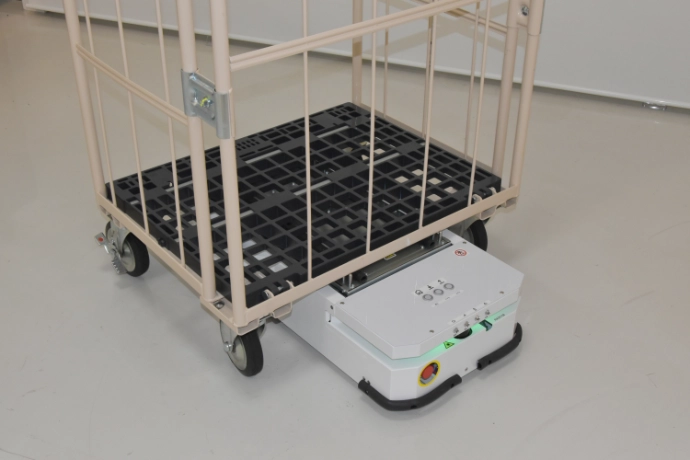
Rally is a robot designed to assist staff working in retail stores such as home improvement centers and supermarkets. It supports a variety of tasks that arise within the store, including transporting carts used for stocking shelves, as well as promotional activities, cleaning, and patrols. As labor shortages become more severe, we believe it will become an indispensable part of future store operations.
It all started when we heard about various challenges from our customers while rolling out the Quist smart locker system. Among these, the most common concern was the burden of in-store logistics. As we discussed this internally, we wondered if we could solve this problem with robots, and that’s how the development of Rally began.
When we visited actual stores, we observed that stocking operations involved moving carts weighing hundreds of kilograms. That work was concentrated during limited time slots, early in the morning or after closing.
In supermarkets in particular, stocking often takes place between around 6:00 a.m. and opening time, and there are instances where elderly staff or employees of small stature have to handle these heavy carts. This poses not only a physical burden but also safety risks. Witnessing these on-site challenges firsthand and asking ourselves, “Could robots provide support?” was the starting point for Rally’s development.
Our goal is to create an environment where people and robots can work together, leveraging each other’s strengths. By having robots handle the heavy lifting, we aim to create an environment where staff can focus on the tasks they should be prioritizing, such as customer service, merchandising, and interacting with customers.
More than just development: the challenges faced by young leaders taking on the role of building new businesses
Alongside business development, as a development leader, I oversee the mechanical, hardware, and software designers. I’m also personally involved in software development and handle sales proposals to clients. Since this is business development, it’s not enough to just focus on development. We conduct PoCs (Proof of Concept) at clients’ sites, verifying how the system can be utilized in real-world environments while continuously making improvements.
Another key part of my role is listening directly to customers, understanding market needs and operational challenges, and providing that feedback to the development team. It feels a lot like growing both the product and the business at the same time.
It’s true that I’m entrusted with a wide range of responsibilities. Of course, I don’t work on my own. I consult with my superiors and relevant departments as I proceed. But I think one of Fuji’s greatest appeals is that it gives everyone the opportunity to take on challenges, regardless of age or seniority. It's a wonderful environment for anyone looking to try something new, isn't it?
Operating robots in unfamiliar environments: refining practicality through proof of concept
The biggest challenge is ensuring stable robot operation in the highly dynamic environment of a retail store. While equipment and layouts are often kept consistent in factories, conditions in retail stores change daily. The location of goods stored in the backroom can shift, and the layout of the aisles is never the same.
The types and sizes of carts used vary from store to store. Every time we introduced the robot to a new site, new challenges emerged, and we had to address them one by one.
Also, Rally isn't just a robot. We needed to build the entire system, embedded software, backend systems that manage the devices, and the web interfaces used by customers. Since this requires expertise across a very broad range of technical fields, I’m constantly learning new things.
What really struck me was the stark difference between the manufacturing and retail industries. In manufacturing, it’s common to follow set procedures, but in retail stores, flexibility is required to adapt to daily conditions. Rather than making the workplace adapt to the robots, we needed to design the robots and their operational methods to fit the actual work environment.
Through proof of concepts, we repeatedly improved the robot based on feedback from frontline users, and one customer comment especially left a lasting impression on me. Shortly after the system was introduced, the store manager at a location where it was actually in use told us that morning tasks had become easier and that they were now able to tackle the rest of their work with more energy.
During stocking tasks, staff sometimes handle carts weighing 300 to 500 kg, so the physical strain is by no means small. It became obvious how having Rally handle those tasks reduced the burden on staff. It was the moment when we realized that the robot we developed was actually helping and improving people’s working conditions, even if only slightly.
Fuji’s culture where anyone of any age or tenure can take on new challenges
I think it’s the opportunity to take on new challenges regardless of age or tenure. We have many engineers with diverse areas of expertise, so I can easily consult with them when I’m stuck. It is precisely because of this environment that I feel there are many opportunities for me to grow as an engineer.
Toward a future where humans and robots work together
In the future, we aim to make Rally a presence not only in supermarkets and home improvement stores, but also in various other retail stores and commercial facilities. It would be wonderful if it became a common sight in stores, much like the food-serving robots found in family restaurants.
We want to evolve Rally from a simple transport robot into a member of the store staff. As labor shortages continue to grow, we hope to create an environment where everyone can work with peace of mind. Ultimately, we want to create a future where people and robots can leverage their strengths to work together.


Related Stories


Sharing the story of our journey