
Corporate Governance
Basic Views on Corporate Governance
Fuji Group views working to create higher corporate value for shareholders, customers, business partners, local community, and employees to be the most important issue. Accordingly, the Group is working to establish and enhance fair and transparent management systems, an organizational structure that can respond to changes in the management environment promptly and accurately, and to strengthen its risk management and compliance system.
Corporate Governance System Overview
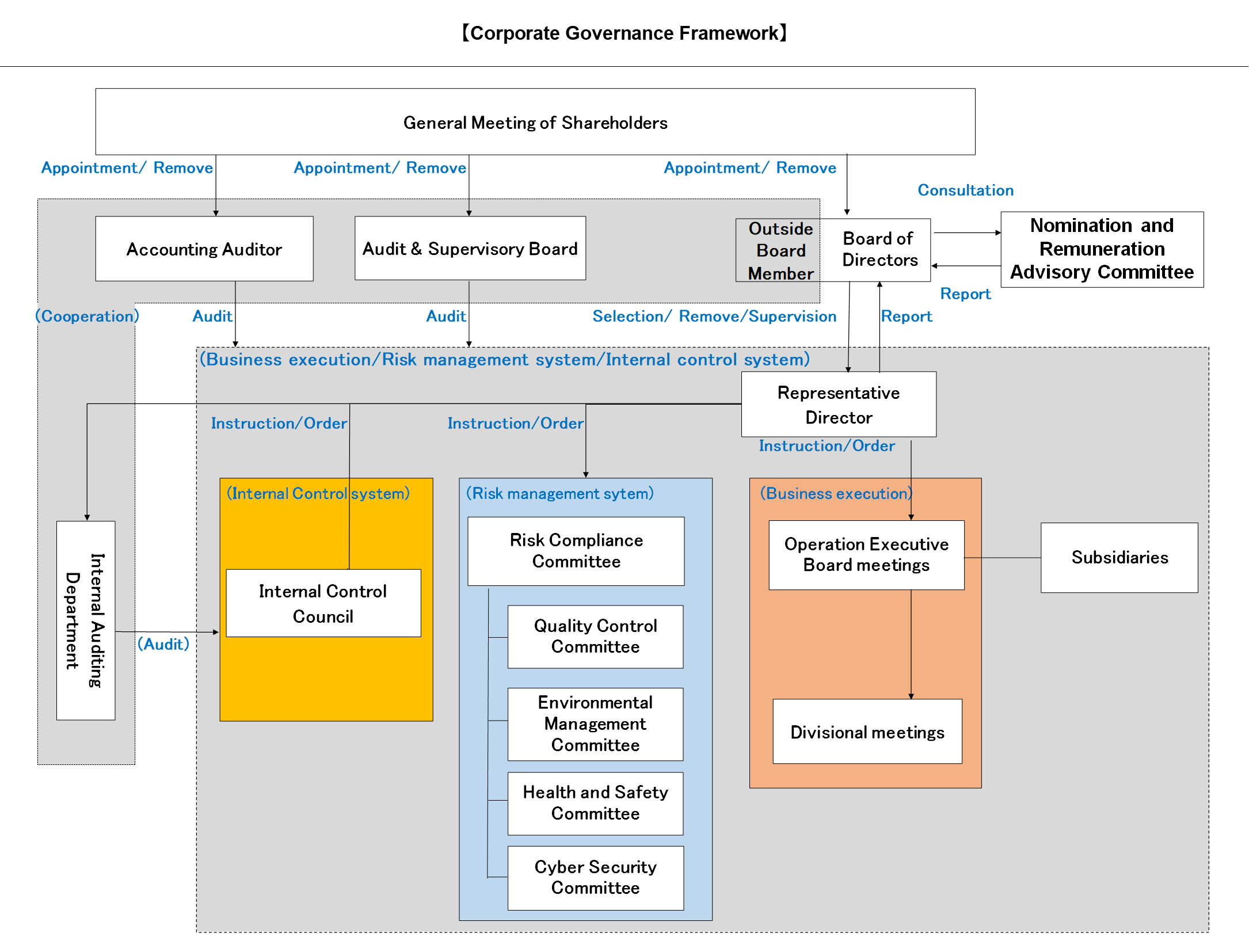
An Audit and Supervisory Board is part of our corporate governance system.
Not only in regular monthly board meetings, but also in extraordinary board meetings which are held as necessary, the board makes decisions on the matters stipulated by laws and regulations as well as other important administrative matters, and oversee the execution of business operations. As of June 27, 2026 there were six board members including two outside board members. As of June 27, 2026 there were three Audit and Supervisory Board members, including two outside auditors. Auditors attend board meetings, hold Audit and Supervisory Board meetings monthly and when otherwise required, they audit the legality of corporate management and the performance of duties by directors.
In order to separate the decision making process for the management and the execution function for the business, thereby enhancing the speed for the management and to clarify responsibilities, we introduced the executive officer system which in addition to delegating authorities to executive officers, makes them responsible for execution of business operations. They report on the execution of business and determine policies in operation executive board meetings, both regular and extraordinary. Every year in the execution of business activities, we establish the business policies and annual (interim) earnings plans to clarify business goals and manage how to achieve the goals set for each department. As of June 27, 2026 there were eleven Executive Officers, (including three board members).
Operation executive board meetings involve reporting on operation performance of each group company, and are where we encourage enforcing corporate governance throughout the Group.
Directors & Auditors (Skills Matrix)
| Name Title at Fuji | Nomination and remuneration advisory committee | Presidential leadership | Manufacturing, technology, R&D | Sales and marketing | Finance and accounting | IT and DX | Legal and governance | Sustainability | International expertise |
|---|---|---|---|---|---|---|---|---|---|
| Joji Isozumi Representative Director, President, and CEO | O | O | O | O | O | O | O | ||
| Junichi Kano Board Member, and CFO | O | O | O | O | O | O | O | ||
| Takeshi Sato Board Member | O | O | O | ||||||
| Domingos Masaharo Tomyama Board Member | O | O | O | O | |||||
| Shoji Mizuno Board Member / Outside, Independent | ◎ | O | O | O | O | O | |||
| Chiharu Ueno Board Member / Outside, Independent | O | O | O | ||||||
| Takatoshi Suzuki Full-time auditor | O | O | |||||||
| Kayoko Yamashita Auditor / Outside, Independent | O | ||||||||
| Yoko Noda Auditor / Outside, Independent | O |
- *The "◎" symbol represents the chairman of the committee.
Establishment of the Nomination and Remuneration Advisory Committee
The nomination and compensation advisory committee was established in April 2021 as an advisory body for the board in order to enhance the fairness, transparency, and objectivity of procedures related to the nomination and remuneration of directors, executive officers, and auditors, and to enhance Fuji's corporate governance. The committee deliberates and reports on the nomination and remuneration of directors, executive officers, and auditors.
Policy for Determining Directors' Compensation
In determining the remuneration of individual directors, the company provides "fixed remuneration" for each position and "performance-linked remuneration" based on the individual performance for the entire company and individuals so that it serve as an incentive for the sustainable enhancement of corporate values. Followed by resolution of the limit to remuneration for restricted share awards at the 75th Ordinary General Meeting of Shareholders held on June 29, 2021, a part of fixed remuneration shall be paid in the form of the restricted share awards. For outside directors, in consideration of their duties, only fixed remuneration shall be paid, and the performance-linked remuneration and restricted share awards shall not be granted. The fixed remuneration shall be comprehensively determined, taking into account the position, responsibilities, years of service, Fuji's business performance, and the level of employees' salaries. The performance-linked remuneration consists of "performance-linked remuneration (company-wide)" and "performance-linked remuneration (individual)." The performance-linked remuneration (company-wide) is remuneration according to the business performance in consideration of the previous year's results of "consolidated operating profit" and "consolidated ROE" that Fuji emphasizes as management indicators as well as the ESG indicators including environmental issues, diversity, and health and work styles. The performance-linked remuneration (individual) is based on an evaluation of the individual performance of each director.
How Corporate Governance System Works at Fuji
Fuji is striving to establish an efficient corporate management system by having a small number of directors to make decisions promptly and engage the board with active deliberations, and by introducing an executive officer system to boost the speed of corporate management and clarify responsibilities. Fuji is also working to develop a framework to enhance the fairness and transparency of corporate management through the holding of internal control council meetings and the operation of the risk and compliance committee. Outside directors provide advice and recommendations at board meetings from their respective experiences and professional perspectives. The Audit & Supervisory Board, which is structured to include outside corporate auditors, is working to enhance and strengthen the corporate audit system and strengthen the functional monitoring of corporate management.
Improving the Effectiveness of the Board
In order for the Board of Directors to fulfill its roles and responsibilities effectively, the structure and operation of the Board of Directors is regularly reviewed to ensure that it is functioning properly so that we can clarify issues and improve the problem areas as well as reinforce its strengths.
Regarding the evaluation of the effectiveness of the Board of Directors, a survey to assess the effectiveness of the Board of Directors was administered to all Board Members and Audit & Supervisory Board Members in March 2026.
The questions in the survey are reviewed annually. Questions covered matters related to sustainability, including addressing environmental problems caused by climate change and respect for human rights. In fiscal 2026, a total of 21 questions in five categories were evaluated on a 5-point scale. This survey was designed so that entry was mandatory, with free entry sections for each category.
- 1Composition and management of the Board
- 2Management and business strategies
- 3Performance monitoring and management evaluation and compensation
- 4Business ethics and risk management
- 5Dialogue with shareholders and other stakeholders
Analysis and evaluation of the survey results confirmed improvements in areas such as management strategy, business strategy, and dialogue with shareholders and other stakeholders. However, the results also indicated that further efforts are needed regarding governance initiatives at overseas subsidiaries. Based on these results, we will strive to further enhance the effectiveness of the Board of Directors by deepening discussions on improving governance within our entire Group, not within Fuji alone.
Basic Views on Cross-Shareholdings
Policies for cross-shareholdings
Fuji holds shares of other companies for seeking to establish and strengthen business relationships that contribute towards the expansion and development of business as well as stability and efficiency. It is our policy to make a comprehensive judgment on whether the holding of individual stocks is rational and appropriate while assessing the level of the Fuji's cost in terms of capital and the level of ROE of the target companies from the perspective of capital efficiency. Every year, the board examines and confirms the appropriateness of holding such stocks from companies, including their relationship with Fuji's business and their contribution to the future direction of Fuji's business.
In May 2024, we released our medium-term management plan for the period from fiscal 2025 to 2027, in which appropriate allocation of managerial resources is highlighted. We will generate 7 billion yen through measures such as reducing cross-shareholdings and allocate it to growth investments and returns to shareholders. By the end of March 2026, we had generated 8 billion yen by reducing our strategic equity holdings, and we will continue to reduce these holdings.
| End of March 2022 | End of March 2023 | End of March 2024 | End of March 2025 | End of March 2026 | ||
|---|---|---|---|---|---|---|
| Number of issues (stocks) | Listed | 29 | 26 | 25 | 23 | 20 |
| Unlisted | 6 | 6 | 6 | 6 | 6 | |
| Total | 35 | 32 | 31 | 29 | 26 | |
| Including amount on the balance sheet (millions of yen) | Listed | 18,458 | 17,784 | 23,588 | 17,878 | 18,762 |
| Unlisted | 35 | 35 | 35 | 35 | 35 | |
| Total | 18,493 | 17,820 | 23,623 | 17,914 | 18,797 | |
| Net assets (millions of yen) | 208,782 | 225,104 | 228,278 | 218,682 | 232,454 | |
| Ratio | 8.90% | 7.90% | 10.30% | 8.20% | 8.08% | |
| Total amount sold related to the decrease in the number of shares (millions of yen) | 3,290 | 2,079 | 446 | 3,130 | 4,930 | |
Basic views on exercise of voting rights
In exercising the voting rights as to cross-shareholdings, Fuji does not make decisions in accordance with uniform standards. Rather, Fuji assesses whether its decisions on the agenda would deteriorate the delivery of potential values to shareholders. Taking into account the business conditions of the issuer companies and other matters in the circumstances, Fuji makes approval or disapproval decisions and exercises the vote rights.
Establishment of Internal Control System
An Internal Audit Department, which reports directly to the Representative Directors, is in place. It audits to check that business operations in each department are executed fairly and reasonably, abiding by articles of association and company regulations. In this system the auditing results are reported to the Representative Directors. Also, with the goal of integrating the structure, preparation, operation, and evaluation of internal controls related to financial reports, Internal Control Council meetings are held presided over by the Representative Directors, for supervising the preparation progress of the system, along with making continuous improvements, to improve the corporate value.
Basic Views on Tax Compliance
Fuji's sustainability philosophy declares "All operations are undertaken in compliance with the applicable laws, social norms, articles of incorporation, and office regulations" in the first of the listing, and Fuji Group Behavior Charter, which stipulates the actions to be taken by all people working for Fuji Group to achieve this philosophy, and sets clearer standards for the reliability of financial reporting.
In addition, CFO supervises matters with regard to tax risks and reports to the board of directors. In the event of uncertainty regarding the application or interpretation of laws and regulations, appropriate measures are taken followed by seeking advice from outside experts.
We will comply with the laws and regulations of each country and region where we conduct business activities, with respect to the rules and backgrounds thereof. We are committed to fulfilling our obligation to pay appropriate taxes as a responsible tax payer.
Tax-related risk management and governance approach
We view tax payment as an important element of corporate social responsibility (CSR). We believe that the tax payments made by Fuji Group play an important role in the development of the region. We believe that this will in turn lead to the sustainable development and enhancement of the corporate value of Fuji Group.
Identifying tax-related risks as an important element among broad business risks confronted with Fuji Group, we give due consideration in their management.
Prohibition of tax avoidance and views on tax planning
Fuji will not engage in tax planning using a base that is not the base of business operations or that involves artificial or aggressive transactions or structures that are undertaken only for tax reasons. All intercompany transactions within Fuji Group are conducted in accordance with the arm's length principle, in line with OECD Transfer Pricing guidelines as well as local laws and regulations.
Handling tax risks
When uncertain or complex concerns arise, advice from outside experts may be sought. For significant risks, including a risk of double taxation, we will consider effective measures, such as the Advance Pricing Arrangement (APA), to increase the relevance and certainty of our stance.


Facing challenges drives the future.
DNA that never stops evolving.
Human stories woven through technology.