
An Unexpected Opportunity in India | From a young engineer with little experience to making an impact at overseas sites
- From astronomy to Fuji - How AMRs inspired the decision to join
- From a conversation at an exhibition to a new challenge in India
- Making every interaction count - the challenges we faced on-site overseas
- "We are grateful you came." – Building trust on-site around the world
- Turning science fiction to factory reality, together
We spoke with a young engineer who joined the company with an astronomy degree and little experience in programming or communicating in English. Today, he works as an AMR software designer, helping to automate user factories around the world.
The turning point came in his fifth year with the company, on an evening when his manager presented him with an unexpected challenge. We spoke with him about how he went from starting with almost no experience to becoming a reliable engineer at worksites overseas.
From astronomy to Fuji - How AMRs sparked a career decision
I work in the Smart Factory Development Department, where I am responsible for the AMR operation management software. I joined the company right out of college, and this is my seventh year here. On my days off, I usually get some exercise by playing basketball or futsal, or I go to watch soccer matches.
That's right. I majored in astronomy in the physics department, and my only experience with programming was a little Python in class. So, I was pretty much a beginner. It all started when I was looking for a company to work for in Aichi and I heard a representative from Fuji’s HR department speak at a company information session at my university.
Seeing the AMR in action at the headquarters showroom was what convinced me to join Fuji. Hearing that Fuji planned to take on more automation challenges really caught my interest. When I was asked which area I'd like to work in, I didn't have any experience in software, mechanical, or electrical engineering. I chose software, thinking that was the one I was most familiar with.
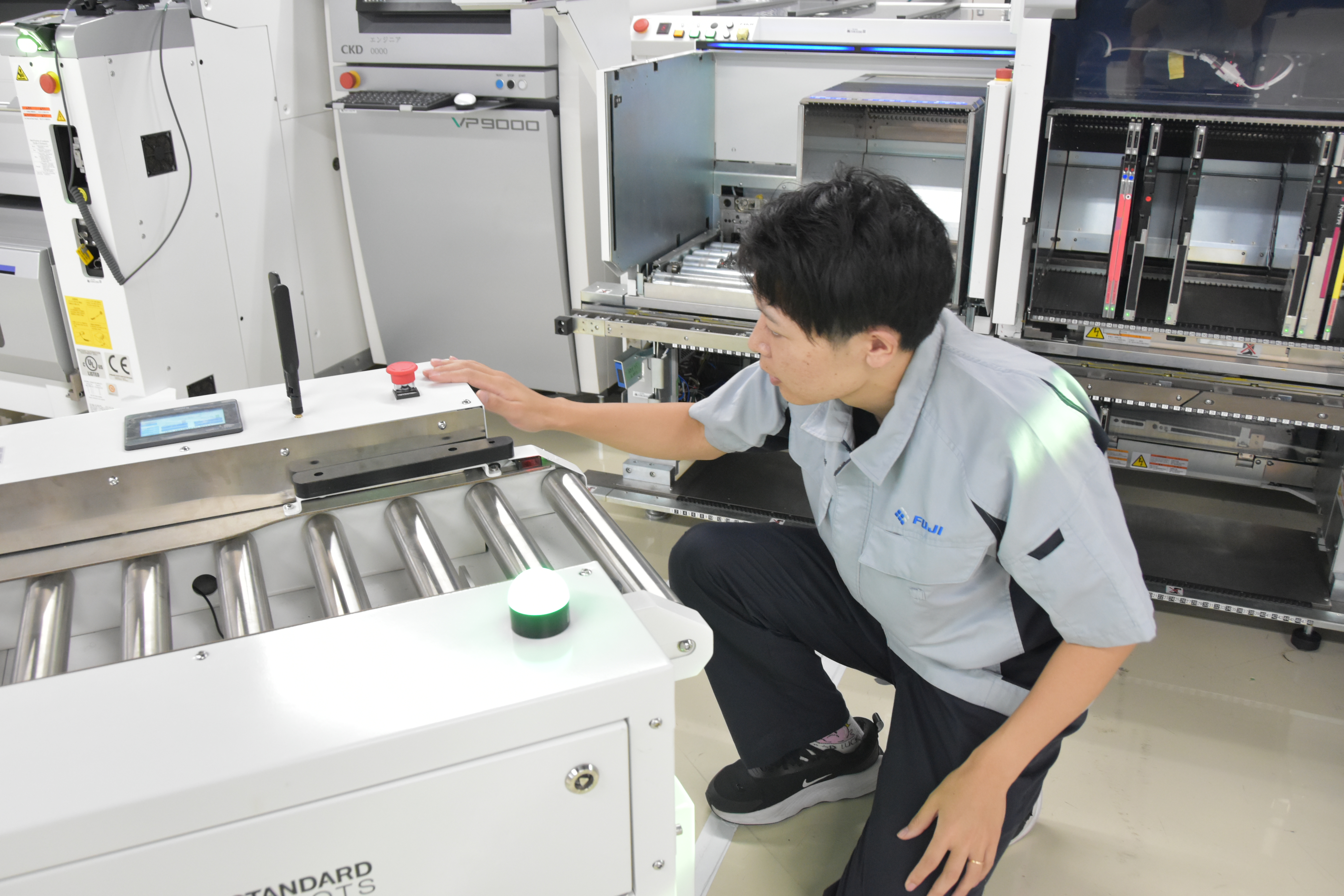
I am developing AMR operation management software and proposing solutions for using it. Many users are looking to reduce their labor requirements, such as by reducing the number of workers needed to transport components from three to two. During the day, AMRs are used to gather and transport components, so that production can continue at night even when no one is there. We visit users' production sites and work with them to envision the system.
I used to think of design as a solitary task, sitting quietly in front of a computer. But in reality, I mostly work alongside the sales teams and other departments. It is completely different from what I had imagined before joining the company.
From a conversation at an exhibition to a new challenge in India
I was asked during an exhibition in January 2024. One evening, I was invited to have drinks with my department and section managers. As we were talking over drinks, one of them unexpectedly asked, "What do you think about an opportunity in India?" I couldn't make a decision on the spot, so I asked for some time to consider it. In the end, I went for six months, starting in November of that year.
I would have expected the company to choose someone who has more experience and stronger English skills for a six-month overseas assignment. But my manager's philosophy was that skills could be developed through experience and what mattered most was the willingness to try. They were supportive of my overseas assignment despite my limited experience. There are plenty of opportunities to take on new challenges, and they're open to everyone. That's what I find most appealing about working at Fuji.
Not very, to be honest. Most of my experience with English came from studying for exams like the TOEIC in university, so while I could read English, my speaking skills still needed some work. I practiced using the company's online English conversation program and, by then, I felt I could manage simple conversations.
But I knew the only way to improve was to practice speaking, so I decided to just go for it. You'd be surprised what you can do when you're pushed outside your comfort zone. Nowadays, meetings with international clients are generally conducted in English. When we go to make a proposal, it is just the sales representative and me, and I am the one who explains the process. I draw out what the other party truly wants to achieve and what challenges they face on the floor, all in English, and then incorporate those insights into features and operational practices. It is not easy, but it is satisfying when I get a clear sense of what the user is aiming for and the proposal is accepted.
Making every interaction count - the challenges we faced on-site overseas
I had to tackle challenges outside my area of expertise. It is necessary to handle equipment other than AMRs on-site. As an engineer, I cannot simply say, "I can't help because that's not my specialty." Even with equipment I was not familiar with, I read the manuals and did everything I could.
That's right. When we could not figure it out on our own, we had no choice but to have the engineers at headquarters look into it. The main obstacle for this is the time difference. In India, once it is past 1:30 p.m. local time, the workday in Japan is already over. Our work was just about to begin, but we only had limited time to consult with the engineers in Japan.
By the time we started our workday, our colleagues in Japan had already been working for three or four hours, so we had only time to communicate a couple times a day. I would send our inquiries after finishing my work on-site, and then have someone at headquarters look into it first thing in the morning.
At that time, I was careful to provide thorough background information, including when the issue occurred and whether things had been working properly before that. If there is not enough information, you might wake up in the morning to find questions waiting for you instead of solutions. I put a lot of thought into what I sent, making sure everything could be investigated thoroughly in one go. The key was figuring out how to make the most of each individual interaction.
"We are grateful you came." – Building trust on-site around the world
There is a project for a large user with nearly 10 factories across more than 5 countries. The user wants to standardize operation across all their locations as much as possible. This makes it easier for them to handle training and provide support in-house. However, since the products manufactured and the ways parts are used differ from place to place, we cannot simply standardize them as is. At times, I would travel to each location once a month to streamline operation, and by implementing versatile software, we have now consolidated their processes into two main operations. Ideally there should be just one operation, so we still have a ways to go.
It was a "thank you" from a contact at an overseas user's factory, from someone known for having exceptionally high expectations.
This past May, I went on a business trip to that site for about three weeks. Originally, a veteran engineer was supposed to go as well. In the end, they were not able to join, so I went by myself. Honestly, my first reaction was "Wait, me?" (laughs).
While there, I promptly addressed every issue that arose and made suggestions about how the user could achieve what they wanted to do next. So, when I went to say goodbye on the day I was leaving, he said, "We are grateful you came. You really helped us out. Thank you." Hearing that from someone who never settles for less made me feel like I had managed to make a difference.
It's about clearly outlining what Fuji can accomplish and by when, and mapping out the path to the goal. If that is not clear, it is hard to get agreement. Another thing is to greet people in their local language. For example, since languages in India vary greatly from region to region, greeting an operator with a few words in their local language can make them very happy. In the end, I think that no matter where you go, it all comes down to people.
Making the factories of the movies a reality, together
I think there are plenty of opportunities. There is also a program called the "Multi-Skill Development Program" which allows design engineers to gain experience overseas for a year. From what I have observed, it seems that those who put themselves forward do indeed get opportunities.
It was when I saw, at an overseas user's factory, AMRs departing one after another for over 10 SMT lines (production lines that mount electronic components onto circuit boards), transporting components and then returning. An automated factory, the kind you see in movies, had actually been built. It was the first time I had seen a worksite that advanced, and I was incredibly impressed. The user was also delighted that one of their visions had become a reality.
Providing something of value to our users. That is why I take on new challenges every day and continually strive to improve. That is where I really felt Fuji's spirit.
At Fuji, our software, hardware, and mechanical engineering teams work together across departmental boundaries, united by a single goal: the automation of SMT lines. It's not a goal that can be easily achieved, but it would definitely be exciting to turn the kind of automated factories seen in movies into reality. I would love to take on that challenge together with those of you who join Fuji in the future.
There are plenty of opportunities to work with overseas partners, so I think that Fuji is also a great fit for people who enjoy engaging with various countries and cultures.
When I joined, I could barely speak English and had very little experience with software. It is okay to start from zero. As long as you are willing to learn and grow, you'll do just fine at Fuji.


Related Stories


Sharing the story of our journey