
Compliance With TCFD
Participation in the GX Future Consortium

We consider that one of the most important issues in building a sustainable society is to respond to climate change by reducing CO2 emissions. We are investigating and analyzing the risks and opportunities posed by climate change in relation to our business activities, and reflecting the results of our analysis to our management strategies while calculating the financial impact.
In June 2022, we announced our endorsement of the TCFD (Task Force on Climate-related Financial Disclosure) and have since been working on disclosing information related to climate change.
In February 2025, we joined the TCFD Consortium to strengthen our response to this initiative.
Following the establishment of the GX Future Consortium in April 2026, we continue to participate as a member and promote initiatives toward decarbonization through our efforts to address climate change, thereby contributing to the realization of a sustainable society.
Governance
Since climate change issues can be pose both risks and opportunities for our "corporate value" and "business activities", we will report our progress in addressing climate change to our directors and executive officers twice a year at the "sustainability promotion committee". This committee will serve the function of decision-making and supervision, effectively implementing the PDCA cycle. Issues that have a significant impact on the business are treated as a matter for report and placed on the agenda for the Board of Directors.
The environmental awareness subcommittee, which aims to promote environmental responsiveness, and each business division make recommendations on capital investment and business plans to the sustainability promotion committee and report on their progress.
Strategy
We conducted a scenario analysis of the impact of climate change on our business activities.*3
Targeted items were identified from current and potential future transition risks (policy and regulation, technology, market, and reputation), physical risks (acute and chronic), transition opportunities (products and services, markets, and resilience), and physical opportunities (acute). Based on the information released by the Intergovernmental Panel on Climate Change (IPCC) and the International Energy Agency (IEA), we have set out a 1.5 degrees Celsius scenario*1 and a 4 degrees Celsius scenario*2 using the year 2030 as a marker. In terms of physical risks, we obtained data relating to future forecasts based on observed and projected climate change data from the climate change adaptation information platform (A-PLAT). As for business, we expect to see an increase in the various IoT devices needed to realize Society 5.0 and a shift toward automated solutions in factories and other facilities. From this information, we organized the viewpoints for the 1.5 degrees Celsius and 4 degrees Celsius scenarios, envisioned what our future society might look like, and conducted a five forces analysis consisting of new entrants, sellers, buyers, substitutes, and industries orbiting our own company.
- *1: Scenario in which the global average temperature rises approximately 1.5 degrees Celsius above pre-industrial levels (IPCC SSP1-1.9、IEA NZE2050)
- *2: Scenario in which the global average temperature rises approximately 4 degrees Celsius above pre-industrial levels (IPCC SSP5-8.5)
- *3: The scenario was revised from one in which the global average temperature rises approximately 2 degrees Celsius above pre-industrial levels to one in which it rises
Risk management
A Risk Compliance Committee presided over by the Representative Director is in place to adequately manage the risks which surround our business to support the setup of risk management systems for each department, and to analyze each type of risk surrounding our business and promote measures for responding to events that may have significant impact.
Risks and opportunities related to climate change are reviewed annually for each business division. The Environmental Management Committee monitors the status of reviewed updates and activities to progress up the spiral of the PDCA cycle on a company-wide level. Information is regularly shared with the Sustainability Promotion Committee and the Board to prevent risks from occurring and minimize their impact through appropriate management and response.
Indicators and targets
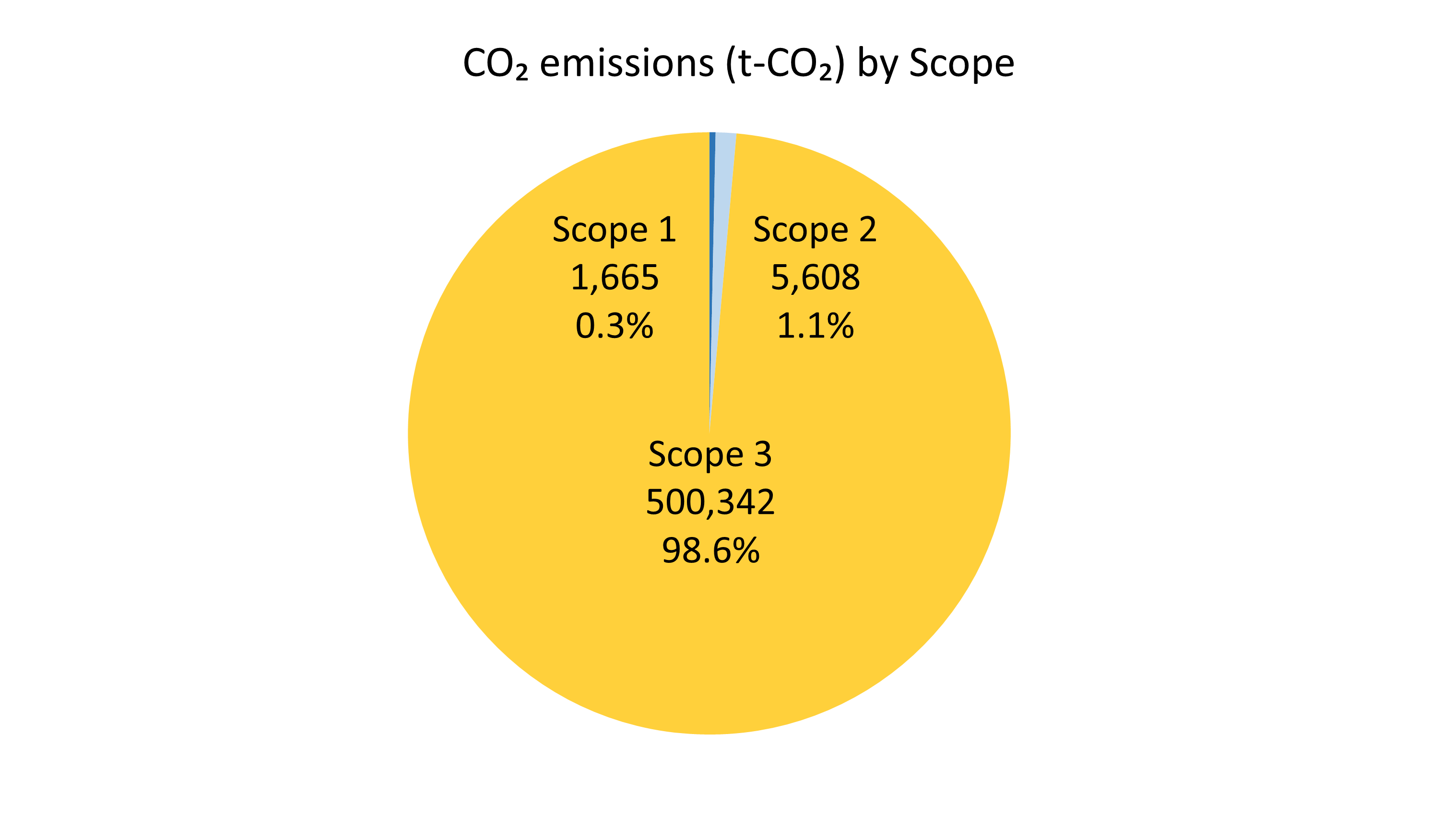
With CO2 emissions as an indicator of climate change, we have set a medium-term environmental target of a 46% reduction in CO2 emissions in scope 1 (direct emissions by the company) and scope 2 (indirect emissions from energy use by the company) by fiscal 2031 based on the fiscal 2014 level. In April 2023, the Sustainability Promotion Committee set our long-term goals toward carbon neutrality, with "Challenge to become carbon neutral by 2050" for scope 1 and 2, and "Reduce CO2 emissions for net sales per unit by 80% by 2050 (compared to fiscal 2022)" for scope 3.
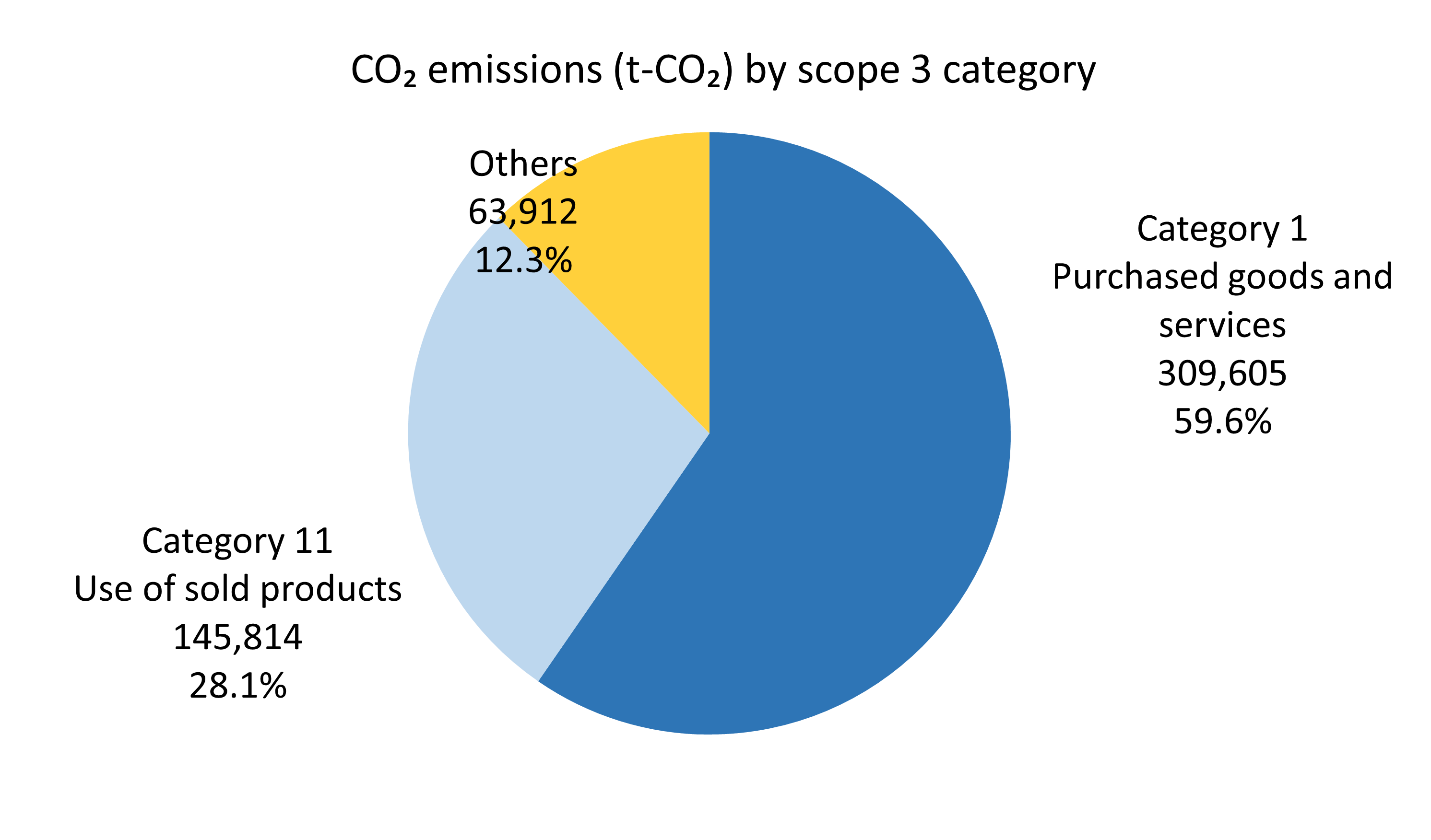
In fiscal 2022, we began calculating emissions in scope 3 (upstream and downstream emissions in the supply chain). The fiscal 2025 results indicate that scope 3 accounts for 98% of emissions from the entire supply chain, excluding category 9 (downstream transportation and distribution), which is still under investigation. The scope 3 emissions are influenced largely by category 1 (purchased products and services) and category 11 (use of sold products). In light with this, we will strive to reduce scope 3 emissions by deepening cooperation with suppliers and promoting environmentally conscious design of products.
Scenario Analysis
The identified risks and opportunities are classified as "major," "medium," or "minor" in terms of their impact on business, and countermeasures are determined for each, incorporated into business activities, and progress is reported to the sustainability promotion committee, thereby repeating the PDCA cycle.
Fuji's main risks and opportunities related to climate change, the degree of impact, and response measures are listed in the table below.
| Risk or opportunity | Transition or physical | Category | Issue | Responses to risks and opportunities | Impact level |
|---|---|---|---|---|---|
| Risk | Transition | Policies and regulations |
|
| Moderate |
| Risk | Transition | Technology and markets |
|
| Moderate |
| Risk | Transition | Market |
|
| Major |
| Risk | Physical | Acute |
| Strengthen business continuity planning (BCP) measures including for the supply chain. | Minor |
| Risk | Physical | Chronic |
|
| Minor |
| Opportunity | Transition | Product and service markets |
|
| Major |
| Opportunity | Transition | Product and service markets |
|
| Moderate |
| Opportunity | Transition | Market |
|
| Moderate |
| Opportunity | Transition | Resilience |
|
| Moderate |
| Opportunity | Physical | Acute |
|
| Minor |
| Risk or opportunity | Transition or physical | Category | Issue | Responses to risks and opportunities | Impact level |
|---|---|---|---|---|---|
| Risk | Physical | Acute |
| Strengthen business continuity planning (BCP) measures including for the supply chain. | Medium |
| Risk | Physical | Chronic |
|
| Medium |
| Opportunity | Transition | Market |
|
| Medium |
| Opportunity | Transition | Resilience |
|
| Medium |
| Opportunity | Physical | Acute |
|
| Minor |
The results of the scenario analysis showed that the 2 degrees Celsius scenario provides an opportunity with solution business focused on increasing factory productivity and energy-saving capabilities, as well as the shift in the automotive field to EV, resulting in greater demand for SMT pick and place machines and machine tools. The risks include increased procurement costs for materials and increased costs for products with low-carbon technologies. Under the 4 degrees Celsius scenario, low carbon emissions will not be promoted and weather-related disasters are expected to become more severe, making it important to address physical risks.
In the future, we will identify financial items among the items that will be highly impacted and continue to gain understanding of the true financial impact of these.


Facing challenges drives the future.
DNA that never stops evolving.
Human stories woven through technology.